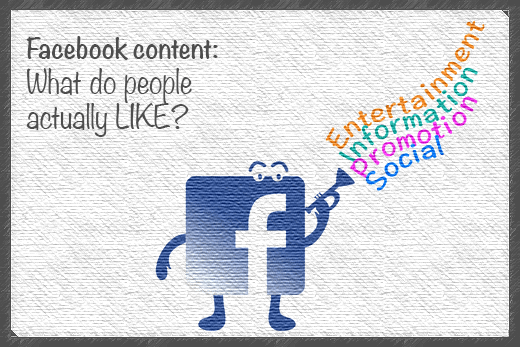
Have you ever thought about what kind of Facebook content is the most popular in terms of likes, comment and shares?
Facebook is the without doubt the most popular social media platform, with more than 50 million companies around the world using Facebook Pages to promote their business! Thus, although Facebook started out as a means for people to connect with each other, today it’s just as much a platform for companies as it is for individuals.
When utilising Facebook it is important that companies choose carefully what kinds of content they post. Of course the content being published must be formulated in such a way that the social media strategy is in tune with the overall branding of the product/business. However, being able to publish the right kind of content at the right time can make all the difference in terms of how successful a company’s social media presence will be. Hosting popular content will not only help get customers to take notice but also possibly further enhance their interaction with the material, for example by them liking, commenting or sharing. Thus, even though the idea is not simply to pump out random content just for the sake of popularity, it is nonetheless important to have an idea of which kinds of content are more likely to be popular and which kinds are not.
Below you can read my advice on how to ensure the highest possible spread of social media content in terms of getting the most likes, comments and shares. For those who want a more in-depth look at the subject, my further argument follows below.
My Advice
Surprisingly (or perhaps not) traditional promotional content doesn’t seem to create a lot of engagement on Facebook. Such content, which includes for example advertisements, games and other traditional marketing campaign material, is usually only intended to directly convince the consumer to buy the product/service. Currently there are way too many Facebook Pages that are promotionally oriented and this has caused most users to become tired of such content. In fact, a recent study by Facebook themselves revealed that users wanted to see much less promotional content on their newsfeed (Facebook, 2014). Therefore, it is obvious that promotional content is not the way to go if the intent is to engage customers through social media.
What actually seems to work best in practice is entertaining content. Entertaining content is something that amazes users and/or makes them smile, while still being easily digestible. A good example would be a witty joke or funny video. However, entertaining content doesn’t necessarily need to be funny, it can also be something interesting and educational. An example would be a brief glimpse into the company’s history, pointing out some interesting fact or having employees explain who they are and what their role is.
Overall, entertaining content is the most likely to incentivise user engagement, meaning that such content will garner more likes, comments and shares, as well as spread further through the network. By providing users with content that they actually care about, they will feel that the company is creating value for them. This helps establish a connection between the product and the user, since the content won’t feel like an unwelcome intrusion, as would perhaps be the case with a promotional content.
“By providing users with content that they actually care about they will feel that the company is creating value for them.”
Companies should thus keep in mind that their Facebook Page can be a presence that reflects the company in a more intimate way than a normal corporate website would ever do. Through Facebook it is possible to express to users a different side of the company and share some company or brand related content that at least makes their day more amusing, rather than drowning them in an endless flood of promotional posts.
Key Take-Away Points:
- Promotional content doesn’t create a lot of engagement on Facebook
- Users wanted to see much less promotional content on their newsfeed
- Entertaining content is most likely to incentivise user engagement
My Argument
My argument is based on my master‘s thesis which was written in the spring of 2015. Titled: The Effects of Content on Facebook Post Popularity: The Case of Icelandair, the thesis was written in cooperation with Icelandair, Iceland‘s largest airline carrier. Throughout the last decade Icelandair has been very active on social media and has striven to adopt as progressive a social media strategy as possible.
As part of the thesis I analysed 242 posts on Icelandair‘s Facebook Page by organizing them into 4 different post types, i.e. ‘informative’ posts, ‘entertaining’ posts, ‘promotional’ posts and ‘social’ posts. The definitions for each post type were as follows:
Informative:
Informative posts are meant to update customers on various things. It can be something to help the customer make an informed decision or briefly update the customer about the service/product. Informative posts from Icelandair included flight updates, new travel destinations, updates on new services and products that are provided both before take-off and on board.
Entertainment:
Entertainment posts are something that gets the users smiling or catches their attention. The posts don’t have to be considered funny, they can also be interesting and educational. Entertainment posts from Icelandair included interesting pictures, photos and videos. Also included were trivia posts which contain interesting facts about Icelandair or have the purpose of educating the users about something in an interesting way.
Promotion:
Promotional posts are posts that include various types of promotional content as to increase sales or public awareness. In the case of Icelandair, ‘promotional’ posts included various offers, marketing campaigns, Facebook games and contests.
Social:
The last post type is ‘social’ posts. These are posts that have some interactional feature or display in some way social activities, events or humanitarian work.
After having categorized the posts on Icelandair‘s Page in this manner the data was analysed using multiple regression in SPSS. For this more formal analysis I utilized a conceptual framework put forth by Vries, Gensler and Leeflang (2012). However, I adjusted their methodology slightly in order to make it more relevant to the marketing environment of airline carriers.
To get straight to the point, the results were rather clear. ‘Entertaining’ posts were the only ones which were likely to increase post popularity, the regressions showing a statistically significant positive relationship between ‘entertaining’ posts and the number of ‘likes’, ‘comments’ and ‘shares’ on posts. Furthermore, the results indicated that ‘promotional’ posts had a negative effect on the number of ‘likes’ and no statistically significant effect on either the number of ‘comments’ or ‘shares’.
Entertaining’ posts were the only ones which were likely to increase post popularity.
What could be the possible reasons for this? One reason might simply be that some Facebook users like to utilize Facebook as a way to seek out ‘entertaining’ content. Another one might be that entertaining content is perhaps more likely to engage the user at a higher level than traditional promotional content. The additional emotions and reactions evoked by entertainment content offer the user more value than traditional promotional content, which usually focuses mainly on selling some specific product and idea without offering much additional value (unless the user takes the step of actually acquiring said product). Finally it might just be that users are so accustomed to traditional promotional material in other aspects of their lives that they are very good at mentally filtering out such content and thus in most instances won’t even give it a second thought.
Others have conducted similar studies on content popularity and most reach the same conclusion as I have. For example, Shen and Bissell (2013) find that the most popular and engaging post type available to businesses is entertainment content. Furthermore, they believe entertainment content can be used to gather more information about target groups, for example by asking consumers to answer amusing questions or questionnaires. They conclude that entertainment content, rather than pure promotional content, is the way towards maximising the profits of any investment in social marketing.
Swani et al., (2013) reach the same general conclusions. They investigated which content type strategies were the most likely to promote online “word-of- mouth” in the form of the number of ‘likes’ for business-to-business/business-to-consumer and for product/service Facebook accounts. Their findings suggest that business-to-business account posts are more effective if they include corporate brand names and avoid “hard sell” or explicitly commercial statements.
Finally, Hong (2011) researched the motivations users have for communicating with brand fan pages. The results strongly emphasise the importance of entertaining content. Hong also argues that if the structure of the brand fan page is too information-heavy it could result in them failing to meet user’s expectations and not generate user engagement. This furthers the argument that in order for entertainment content to be efficient it should be easily digestible.
To Summarise
Companies should focus on creating content that is perceived by Facebook users as being of some value to them. Entertainment content has shown that it can create certain value for users, since it increases the likelihood that users will engage with it by ‘liking’, ‘commenting’ or ‘sharing it’. Keeping promotional content to minimum also seems sensible since users don’t react much to such content. Therefore, if companies can somehow combine entertaining content with promotional content (in other words, disguise the latter as the former), for instance by sharing some valuable facts about the product/service, they might be on the right track.
Facebook (2014). An Update to News Feed: What it Means for Businesses. Retrieved 24th of July from https://www.facebook.com/business/news/update-to-facebook-news-feed
Hong, M. L. (2011). User Motivations for Using Business Facebook Pages. (Doctoral dissertation, Boise State University).
Shen, B., & Bissell, K. (2013). Social Media, Social Me: A Content Analysis of Beauty Companies’ Use of Facebook in Marketing and Branding. Journal of Promotion Management, 19(5), 629-651.
Swani, K., Milne, G., & P. Brown, B. (2013). Spreading the Word through Likes on Facebook: Evaluating the Message Strategy Effectiveness of Fortune 500
Categories: Facebook

 minimarketingadvice.com